Export Employer Record ID
Code
A unique code for the export employer.
Description
A description of the export employer.
Employer tab
General
Other EIN
If you have used an EIN (including a prior owner's EIN) on Form 941, Form 943, Form 944, or Form CT-1 that is different from the EIN reported on Form W-3, enter that EIN here. In general, you will leave this field blank and report the employer's EIN.
Establishment Number
The establishment number. Use any combination of blanks, numbers, or letters as necessary. The establishment number can be used to identify separate establishments in your business. For instance, you can use the establishment number to distinguish store or factory locations or to separate different types of payroll. You can file separate Forms W-3 with Forms W-2 for each establishment even if they all have the same EIN, or you can use a single W-3 for all Forms W-2 of the same type. The establishment number identifies each location (defined by an employer reporting under the Establishment Reporting Plan). The Establishment Reporting Plan is an optional reporting method used by some employers with more than one location or type of Payroll Record Unit (PRU), but is not applicable for tax years 1987 and later.
Kind of Employer
The appropriate code for the export employer's organization type. This code is required for electronic reporting (EFW2). Valid codes include:
- F - Federal government
- S - State and local government employer
- T - Tax exempt employer
- Y - State and local tax exempt employer
- N - None apply
Employment Code
The appropriate employment code for the export employer. R is the most commonly used code. Valid codes include:
- A - Agriculture
- H - Household (Schedule H)
- M - Military (Form 941)
- Q - Medicare Qualified Government Employee (Form 941)
- X - Railroad (CT-1)
- F - Regular (Form 944)
- R - Regular (all others) (Form 941)
Tax Jurisdiction Code
If the export employer is located in a U.S. territory, the tax jurisdiction code for the export employer. Valid codes include:
- V - Virgin Islands
- G - Guam
- S - American Samoa
- N - Northern Mariana Islands
- P - Puerto Rico
Name Control
The four-character name control code issued to the export employer by the IRS when it provided the employer with an EIN. This field is used for transmitting 1095-C information to the IRS. This code is optional, so if you're unsure of the name control code, leave this field blank. The IRS may reject your transmission if the value doesn't match their records.
Third-Party Sick Pay
If this checkbox is marked, indicates the export employer is a third-party sick pay payer filing a Form W-2 for an insured's employer or is reporting sick pay payments made by a third party.
Address
Name
The export employer's name.
Location
The export employer's location. This field is typically used for specific address information such as a suite number or room number.
Delivery (Street)
The export employer's delivery address. Use this field to specify a street address or post office box number.
City/State/Zip
The city, state abbreviation, and Zip or Zip+4 Code for the export employer.
Province
If applicable, the province for the export employer's address.
Postal Code
If applicable, the postal code for the export employer's address.
Country
The three-character abbreviation for the export employer's country. For employers in the United States, leave this field blank.
Contact
Name
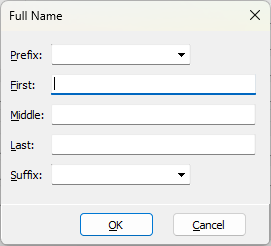
The export employer's contact's name. Click the right arrow to open the Full Name dialog box where you can enter the name in parts. This field and the Full Name dialog box are synced so that changes you make to one are updated to the other.
Job Title
The contact's job title. This field is used to provide the title on the first page of the 1094-C report.
Phone
The contact's phone number.
Phone Ext
If applicable, the contact's phone extension.
Fax
The contact's FAX number.
Email
The contact's email address.
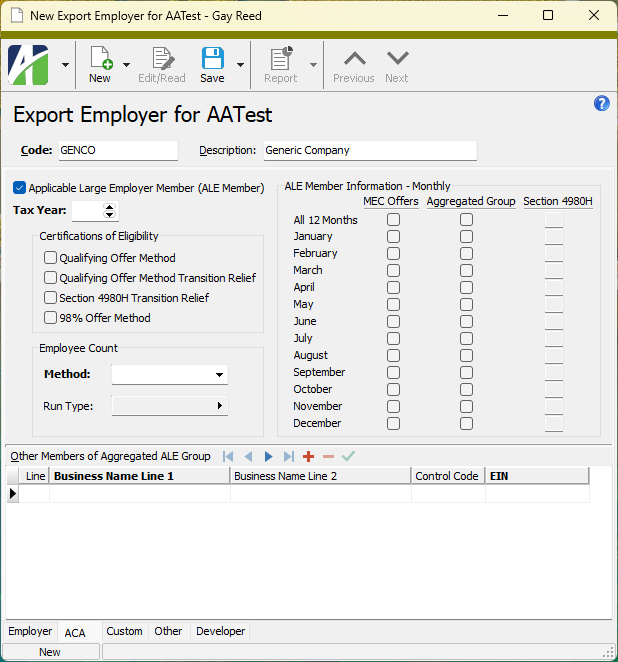
ACA tab
Complete this tab if you use ActivityHD to track and report Affordable Care Act (ACA) information for the employer. This information is used to complete Form 1094-C.
Applicable Large Employer Member (ALE Member)
If this checkbox is marked, indicates the employer is an Applicable Large Employer Member. When you mark the checkbox, the remaining controls on the tab are enabled.
Tax Year
The four-digit tax year for ACA reporting.
Certifications of Eligibility
The marked checkboxes indicate the filing method or relief type the employer certifies eligibility for.
Qualifying Offer Method
If this checkbox is marked, you certify that the employer is eligible to use and is using the Qualifying Offer Method to report Form 1095-C information for one or more full-time employees for all months during the year for which the employee was a full-time employee for whom the employer shared responsibility payment could apply.
Reserved/Qualifying Offer Method Transition Relief
If you entered "2016" or later in the Tax Year field, this checkbox is labeled Reserved and is disabled.
If you entered "2015" in the Tax Year field, this field is labeled Qualifying Offer Method Transition Relief. If this checkbox is marked, you certify that the employer is eligible to use and is using the Qualifying Offer Method Transition Relief for 2015 to report Form 1095-C information for one or more full-time employees. To qualify for this relief, the employer must make a Qualifying Offer for one or more months of 2015 to at least 95% of its full-time employees.
Reserved/Section 4980H Transition Relief
If you entered "2017" or later in the Tax Year field, this checkbox is labeled Reserved and is disabled.
If you entered "2016" or earlier in the Tax Year field, this checkbox is labeled Section 4980H Transition Relief. If this checkbox is marked, you certify that the employer is eligible to use and is using the Section 4980H Transition Relief for employers with fewer than 100 employees or for employers with 100 or more employees. If you mark this checkbox, you must also specify which relief you are claiming in the Section 4980H column of the ALE Member Information - Monthly section.
98% Offer Method
If this checkbox is marked, you certify that the employer is eligible to use and is using the 98% Offer Method to report Form 1095-C information. To qualify to use this method the employer must offer affordable health coverage providing minimum value to at least 98% of its employees for whom it is filing a 1095-C employee statement and must also offer minimum essential coverage to those employees' dependents.
Employee Count
Specify how to determine the total employee count for ACA reporting. The total employee count is reported on Form 1094-C.
Method
The day for which to report the monthly total employee count. The total employee count includes full-time employees, non-full-time employees, and employees in a Limited Non-Assessment Period. Your options are:
- Month Begin
- Month End
- Month Day 12
- Pay Period Begin. The first day of the first pay period during the month.
- Pay Period End. The last day of the first pay period during the month.
Run Type
This field is enabled if "Pay Period Begin" or "Pay Period End" is selected in the Method field. This is the payroll run type that is associated with the pay periods being used to determine the total employee count.
ALE Member Information - Monthly
MEC Offers
The marked checkbox(es) in this column indicate the months in which the employer offered minimum essential coverage (MEC) to at least 95% of their full-time employees and their dependents. If the employer offered MEC to at least 95% of their full-time employees and their dependents for all twelve months, the All 12 Months checkbox should be marked.
Aggregated Group
The marked checkbox(es) in this column indicate the months in which the employer was a member of an Aggregated ALE Group. If the employer was a group member for all twelve months, the All 12 Months checkbox should be marked.
Section 4980H
The text boxes in this column are enabled if you mark the Section 4980H Transition Relief checkbox in the Certifications of Eligibility section. For each month the employer is claiming relief, this is the code for the type of relief being claimed. If relief is being claimed for all twelve months, the code should be entered in the All 12 Months text box. Valid codes are:
- A. The employer is eligible for the 50 to 99 Relief.
- B. The employer is eligible for the 100 or More Relief.
An employer cannot be eligible for both types of relief.
Other Members of Aggregated ALE Group table
This table is enabled if any of the checkboxes in the Aggregated Group column in the ALE Member Information - Monthly section are marked. Use this table to enter information about the other members of the Aggregated Group the employer belongs to. Enter the group members in descending order starting with the group member with the highest average monthly number of full-time employees.
Note
If any member of the Aggregated Group uses the 98% Offer Method, all members of the Aggregated Group should report the average monthly number of total employees rather than full-time employees.
Business Name Line 1
The first line of the group member's business name.
Business Name Line 2
If needed, the second line of the group member's business name.
Control Code
The control code assigned to the group member.
EIN
The employer identification number (EIN) of the group member including the dash.
Custom tab
This tab is visible if custom fields exist for the entity. At a minimum, if there are custom fields, a Fields subtab will be present. One or more additional categories of subtabs may also be visible.
Fields subtab
This tab prompts for values for any custom fields set up for entity records of this entity type. Respond to the prompts as appropriate.
References subtab
This tab is visible if other records reference the current record.
Reference
From the drop-down list, select the custom field to view references for. Reference custom fields have the following format: PackageName.EntityName.CustomFieldName.
Example
Suppose a custom field exists on PRCodes that references an ARCode. On the ARCode record, on the Custom > References subtab, you can view all the PRCodes which reference that ARCode.
Exchange Folder subtab
This tab is visible only if you set up a custom field with a data type of "Exchange Folder". The label on this tab is the name assigned to the custom field.
This tab shows the contents of the specified Exchange folder.
File subtab
This tab is visible only if you set up a custom field with a data type of "File". The label on the tab is the name assigned to the custom field.
This tab renders the contents of the specified file according to its file type.
Internet Address subtab
This tab is visible only if you set up a custom field with a data type of "Internet Address". The label on this tab is the name assigned to the custom field.
This tab shows the contents of the specified web page.
Network Folder subtab
This tab is visible only if you set up a custom field with a data type of "Network Folder". The label on this tab is the name assigned to the custom field.
This tab shows the contents of the specified network folder.
The Attachments tab is visible if any record for a given entity has an attachment. If the Attachments tab is not visible, this implies that no record of the entity type has an attachment on it; however, once an attachment is added to any record of the entity type, the Attachments tab will become available.
Attachments
The list box shows the files which are attached to the current record. Highlight a file name to preview the file in the adjacent pane. Double-click a file name to open the file in its native editor.
Preview pane
If a file name is highlighted in the Attachments list box, this pane shows a preview of the file contents. Some file types cannot be previewed but can be double-clicked to open in their native editor.
Change Logs tab
This tab is visible if the user has "Change Logs" access to the associated data folder resource.
The Change Logs pane shows the Change Logs HD view filtered to show all change logs for the selected entity record.
Double-click a row in the pane to drill down to its record in the Change Log window.
Other tab
Memo tab
To include additional information about this record not collected elsewhere, enter it in this text box. This area supports common keyboard shortcuts such as Ctrl+C to copy and Ctrl+V to paste.
Timestamps tab
This tab shows the user who created this record and the date and time of creation as well as the user, date, and time of the latest modification to the record.
Developer tab
This tab is visible only when developer features are enabled.
Automation subtab
This subtab shows field names and values for the current data record. Use the information in the subtab to assist when creating automation objects such as bots and import files. The field names and field values can be copied from the text box and pasted directly into your code or application. To copy content from the text box, highlight the content to copy and press Ctrl+C or right-click your selection and select Copy from the context menu.
Export (XML | JSON) subtab
This subtab shows the XML syntax for exporting the selected data record. The syntax can be copied from the text box as an exemplar for creating your own automation objects for bots, import files, ActivWebAPI, etc. To copy content from the text box, highlight the content to copy and press Ctrl+C or right-click your selection and select Copy from the context menu.
Import (XML | JSON) subtab
This subtab allows you to select a file for import and shows the XML syntax for importing data records. Use the subtab to explore the XML syntax for importing data records. In particular, you can investigate the syntax which results when using Data.Import and ActivWebAPI data POST and DELETE routes.
Change Log (XML | JSON) subtab
This subtab is visible only when the Enable Change Logs option is marked in System Options or Company Options (depending on whether the feature applies at the system or the company level). This is the default setting when developer features are enabled.
This subtab allows you to investigate changes to the current data record. The syntax can be copied for use in bots, dashboards, ActivWebAPI, and other automation. To copy content from the text box, highlight the content to copy and press Ctrl+C or right-click your selection and select Copy from the context menu.
Select Statement (SQL) subtab
This subtab allows you to investigate the SQL select statement used to retrieve the current data record. The syntax can be copied as an exemplar for data sources and other automation. To copy content from the text box, highlight the content to copy and press Ctrl+C or right-click your selection and select Copy from the context menu.
 . The New Export Employer window opens.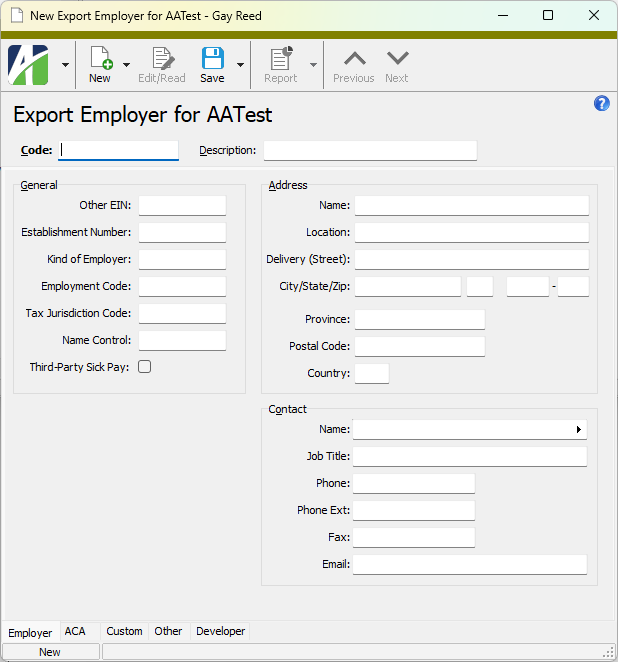
 .
.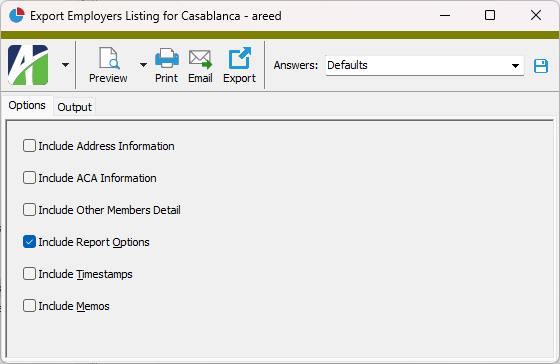
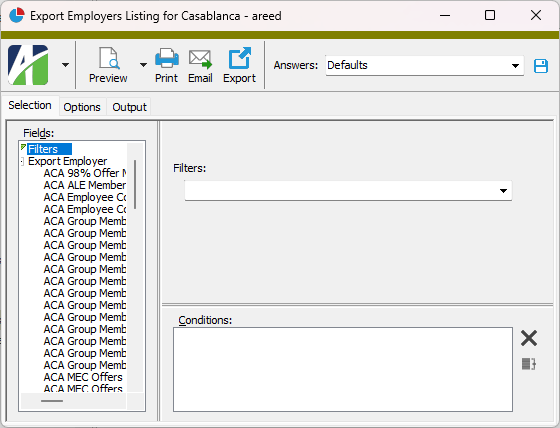
 - Provides access to two preview options.
 - Opens the Print dialog so that you can select and configure a printer and then print a paper copy of the report.
 - Opens the
  - Opens a drop-down menu with two export options: